
How Openmind™ works

Openmind™ is a Psychometric Personality Profiling Tool that provides you with life-changing insights.
It is the ultimate tool for self-awareness.
By combining neuroscience, psychology and advanced technology, Openmind™ measures not just your conscious thoughts, but your underlying, deeper feelings – the hidden drivers of who you are.
For the first time, you can visualise how you feel.
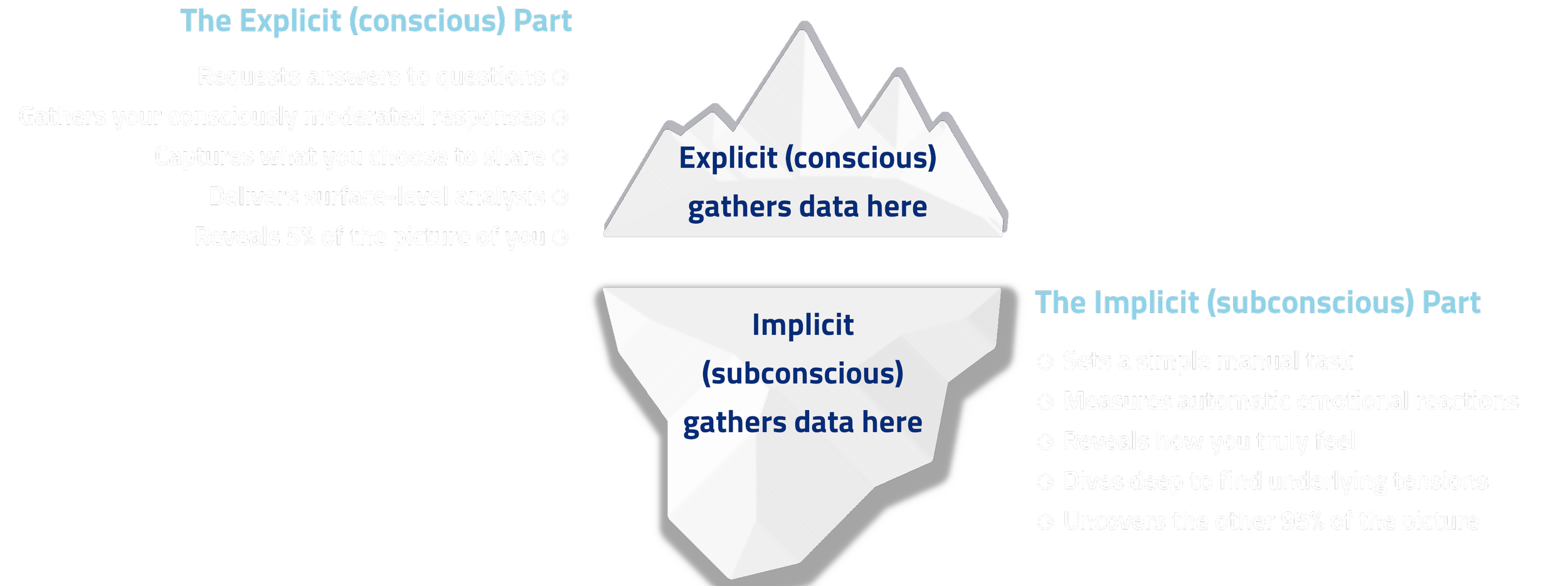
Traditional tools can only access a tiny part of your brain: the conscious part.
Openmind™ unlocks the inaccessible part: the subconscious part. This hidden realm is responsible for shaping your attitudes, beliefs, and personality: it’s who you really are.
Openmind™ Dives Deep Into The Neural Iceberg
It combines two assessment methods: an Explicit Assessment that measures what you think (responses gathered from your conscious mind)
and an Implicit Assessment that measures how you feel, (responses gathered from your subconscious mind) tapping into your deep-seated emotions, beliefs and attitudes. Together, these give you the clearest, most complete picture of yourself.
Quick, straightforward and science-led.
Simple, Easy and Fun to do

Works on any internet-connected device

No difficult or trick questions

Tailor your experience with our Neurodiversity Toolbar™

Certified Openmind™ Practitioners support you all the way


All major languages supported
No long questionnaires – done in 15 minutes or less

The Implicit part works just like a video game
Audio version available
Pinpoint blocks in minutes, not months.
Science Translated into Action
Openmind™ is powered by world-class Neurotech® technology, developed with scientists, using neuroscience born in the lab. This technology gathers, measures and distils complex data into a clear, accessible report that allows you to see how your subconscious brain patterns shape your decisions and actions – and what you can do to drive positive change and take full control of your life. Here’s a glimpse inside a report.
When what you think (explicit) and how you feel deep down (implicit) align
Openness: “I’m very open to new ideas”
Analysis
Ms. X’s responses suggest a moderately high positive openness to new ideas – both implicitly and explicitly. The slightly more positive implicit score indicates that Ms. X may not be fully aware of their strong inclination towards novelty and change. This discrepancy could stem from a subconscious desire to explore new concepts, which is slightly more pronounced than their conscious recognition of this trait.
Explanation
When your thoughts and feelings align, you show self-awareness and act with authenticity. This isn’t a judgment on whether the trait is desirable, it’s just a reflection of how naturally it fits you.
When implicit and explicit responses match, your behaviour in this area is likely effortless and familiar, shaped over time and generally accepted as part of who you are.
This alignment can also signal a deep-seated attitude that may be resistant to change. If a trait shows a strong negative association, it may require significant time and focused effort to shift, highlighting where personal development should be prioritised.
Only Openmind™ can reveal this level of insight into the degree of alignment between what you feel underneath and the actions you take.
Are you ready to finally find the solutions and meet the real YOU?
Do you want to deliver instant, precise, scientific insights for your clients?
When what you think (explicit) and how you feel deep down (implicit) diverge
Conscientiousness: “I consider all the angles before making a decision”
Analysis
Mr. Y’s data suggests a discrepancy between his conscious and subconscious attitudes to decision-making. While he consciously believes he considers all angles before making a decision – indicated by a high positive level of consideration – his implicit response suggests this may not always be the case, hinted at by a lower, more negative level of thoroughness in practice. This could indicate that Mr. Y overestimates his analytical approach when making decisions.
Explanation
When your thoughts and feelings conflict, it suggests this trait causes you stress or tension. Your subconscious may be pushing against your rational viewpoint, which may stem from a strong desire for achievement, or to appear a certain way, influenced by social desirability bias.
This cognitive dissonance indicates you’re probably working against yourself, which takes energy and effort. You may find that you avoid situations linked to this trait because they feel draining. Do you procrastinate?
However, all is not lost. In fact, this situation can be very helpful from a personal development perspective. It reveals a disconnect between who you feel you are and who you want to be, potentially creating powerful motivation for change.
Only Openmind™ can uncover this level of insight into your internal conflicts between what you feel in your gut and the actions you are actually taking.