
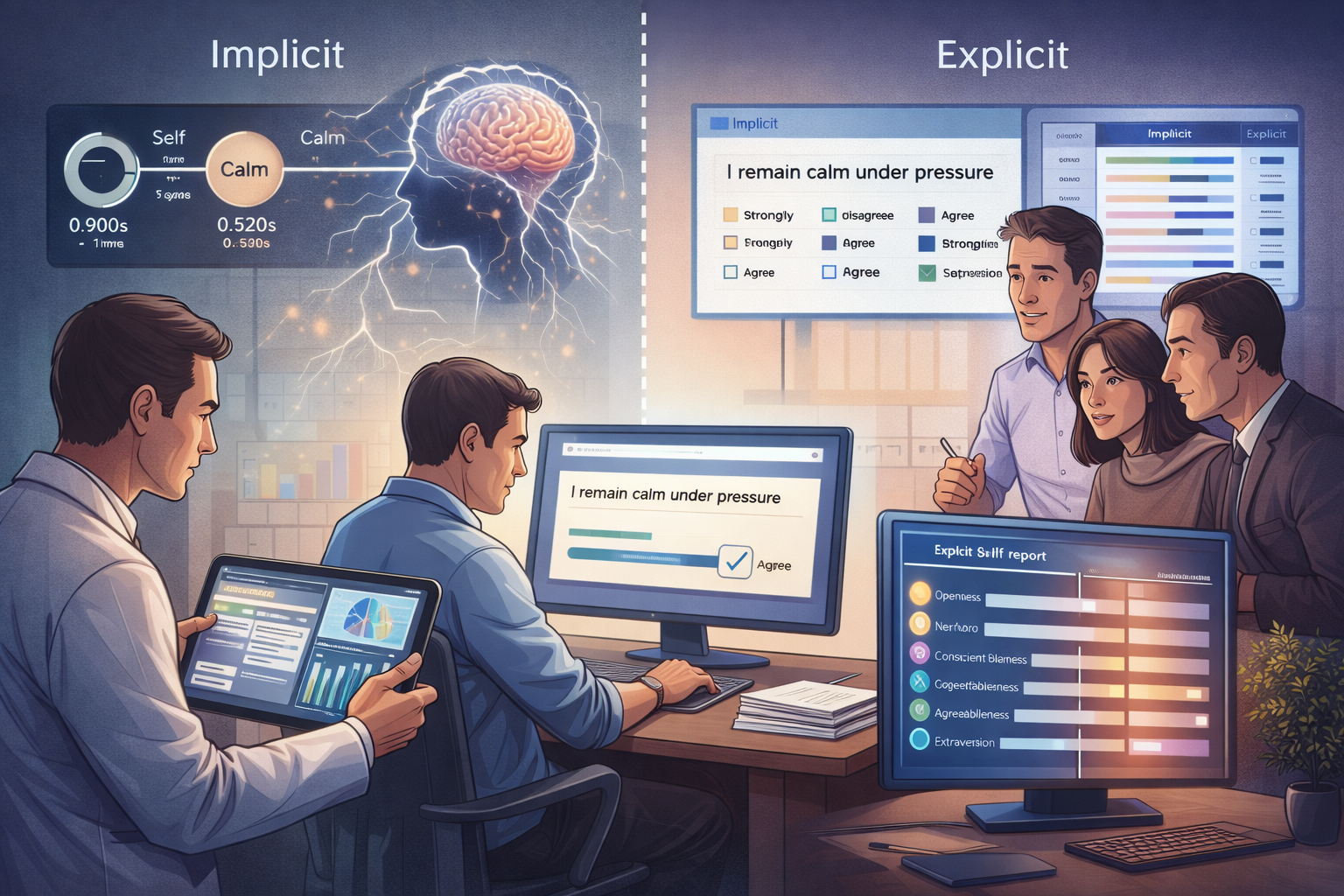
Psychometric testing has been around for well over a century. From early intelligence testing to modern personality questionnaires used in recruitment, leadership development, and coaching, the core idea has remained remarkably stable: ask people questions about themselves and infer something meaningful from their answers.
For a long time, that was considered “good enough”.
But over the last two decades, something uncomfortable has become impossible to ignore. What people say about themselves is often not the same as what actually drives their behaviour. Sometimes that gap is small. Sometimes it’s massive. And sometimes people genuinely have no idea the gap exists.
This is where implicit psychometrics enters the picture – and why it is quietly, but fundamentally, reshaping how personality, attitudes, and self-awareness are measured.
This article explores how implicit psychometrics works, why traditional self-report methods struggle, what the science says, and how modern platforms like Openmind are blending implicit and explicit data to create a much more honest, useful, and human understanding of personality.
The Traditional Psychometric Model – And Its Limits
Most psychometric tools in use today rely on explicit self-reporting. These include well-known personality inventories, values surveys, engagement questionnaires, and behavioural assessments.
The logic is simple:
Ask someone a statement
Get them to rate how much they agree or disagree
Aggregate the results
Infer stable traits or tendencies
This model underpins frameworks such as the Big Five personality traits, which remains the most empirically supported structure for describing personality. Traits like Openness, Conscientiousness, Extraversion, Agreeableness, and Emotional Stability (or Neuroticism) have shown strong predictive value across cultures and contexts.
But even the best framework is constrained by the quality of the data feeding it.
The Self-Report Problem
Explicit questionnaires assume four things that are often untrue:
People know themselves well
People can accurately introspect
People are willing to answer honestly
People interpret questions consistently
In reality, explicit responses are shaped by:
Social desirability bias
Impression management
Fear of judgement
Cultural norms
Self-deception
Aspirational identity (“who I want to be”)
None of this requires bad intentions. Most people are not lying. They are simply answering from their conscious narrative, not from the deeper systems that actually drive reactions, decisions, and behaviour.
This creates a well-documented issue in psychometrics known as construct contamination: the test starts measuring self-presentation as much as personality.
Conscious vs Subconscious Attitudes
Human psychology operates on at least two levels:
Explicit processes: conscious, deliberate, reflective
Implicit processes: automatic, fast, subconscious
Modern neuroscience and cognitive psychology are very clear on this distinction. Much of what we feel, prefer, fear, or avoid happens before conscious reasoning ever gets involved.
A classic reference point here is the Implicit Association Test developed in the late 1990s to measure subconscious associations by analysing reaction times rather than stated beliefs. Read more about this test here: about the Implicit Association Test.
The key insight is simple but powerful:
Speed reveals truth.
When people respond instantly – before they have time to edit themselves – their responses are far more likely to reflect genuine underlying attitudes.
Implicit psychometrics applies this same principle to personality and self-concept.
What Is Implicit Psychometrics?
Implicit psychometrics measures psychological constructs using reaction time, latency, and automatic response patterns, rather than relying solely on conscious self-evaluation.
Instead of asking:
“I am emotionally resilient”
Strongly disagree → Strongly agree
An implicit approach might measure:
How quickly someone associates self with resilient
Whether hesitation or conflict appears during the response
How consistent those reactions are across similar items
The person still answers statements – but the system measures how they answer, not just what they answer.
This distinction matters enormously.
Why Reaction Time Matters
Reaction time is one of the most robust signals in cognitive science. Faster responses indicate stronger, more automatic associations. Slower responses suggest conflict, uncertainty, or weak internal alignment.
In implicit psychometrics:
Fast + consistent responses suggest deeply held attitudes
Slow or conflicted responses suggest internal tension
Implicit–explicit gaps reveal self-awareness mismatches
These gaps are often where the most valuable insights live.
For example:
Someone may explicitly rate themselves as calm under pressure
But show strong implicit associations with stress and overwhelm
That doesn’t mean they’re lying. It means their narrative self and experiential self are out of sync.
The Implicit–Explicit Gap: Why It Matters
One of the most important contributions of implicit psychometrics is the ability to quantify self-awareness.
When implicit and explicit scores align closely, it suggests:
Psychological coherence
High self-insight
Low internal conflict
When they diverge significantly, it can indicate:
Masking or impression management
Internalised expectations
Aspirational identity
Emotional blind spots
Burnout risk
Stress compensation patterns
Traditional psychometrics often collapses these differences into a single score. Implicit methods preserve them – and that changes everything.
A Practical Example
Consider ‘Conscientiousness’.
Explicitly, someone might strongly agree with statements like:
“I am highly organised”
“I always honour my commitments”
But implicit data may reveal hesitation, slower reaction times, or weaker automatic associations.
The result is not a contradiction – it’s a signal.
It may indicate:
Chronic overcompensation
High standards masking exhaustion
Identity pressure (“I must be reliable”)
Stress-driven discipline rather than natural orderliness
These nuances are invisible in traditional self-report tools.
Do you recognise these behaviours in yourself?
Find out how easily you can start to take full control of your life:
Why This Changes Coaching, Leadership, and HR
Implicit psychometrics doesn’t replace existing frameworks – it upgrades them.
When combined with validated trait models like the Big Five, implicit data adds depth, honesty, and diagnostic power.
In Leadership Development
Leaders are especially prone to self-presentation bias. Their explicit profiles often reflect who they believe they should be, not how they actually operate under pressure.
Implicit data helps reveal:
Hidden stress load
Emotional leakage
Confidence vs anxiety mismatches
Authentic vs performative traits
This allows coaching conversations to move beyond surface behaviours into sustainable change.
In Recruitment and Talent Development
Implicit measures reduce:
Coaching-to-the-test effects
Social desirability distortion
Cultural response bias
They don’t label candidates as “good” or “bad” – but they do provide a more realistic view of fit, pressure tolerance, and working style.
In Personal Development
For individuals, the real power is self-awareness.
Seeing where your automatic responses diverge from your conscious beliefs can be confronting – but it’s also liberating. It explains why certain habits, reactions, or struggles persist despite good intentions.
Do you sometimes feel you are your own worst enemy? Would you like to understand what’s going on just out of your reach?
The Science Behind Implicit Measurement
Implicit psychometrics draws from several well-established domains:
Cognitive psychology
Reaction time research
Dual-process theory
Attitude accessibility theory
Neurocognitive load theory
The evidence base supporting reaction-time-based measurement is substantial and continues to grow.
Read a good general overview of implicit cognition: about Implicit Cognition
Importantly, implicit methods are not projective tests and not pseudoscience.
They are structured, repeatable, and statistically analysable.
Addressing the ‘Black Box’ Concern
One criticism sometimes raised is that implicit testing feels opaque. People worry about being “measured without knowing how”.
This concern is valid and responsible platforms address it through:
Transparency in reporting
Clear explanation of implicit vs explicit results
Emphasis on reflection, not judgement
Use in development contexts rather than diagnosis
The goal is insight, not surveillance.
How Blended Models Are Emerging
The most effective modern psychometric systems do not abandon explicit data. Instead, they blend implicit and explicit measures.
This creates three layers of insight:
What you consciously believe about yourself
What your automatic responses reveal
Where those two align – or clash
This blended approach reflects how humans actually work.
Openmind™ and the Next Generation of Psychometrics
One of the clearest real-world examples of this blended approach is Openmind™ (https://openmindglobal.io).
Rather than replacing established personality frameworks, Openmind™ builds on the Big Five while introducing implicit reaction-time measurement alongside traditional explicit responses.
The result is not a single “personality score”, but a layered profile that shows:
Conscious attitudes
Subconscious associations
Degree of internal alignment
Areas of confidence, tension, or blind spots
Crucially, Openmind™ is designed around self-reflection and development, not labelling or ranking people. Its reports are structured to prompt meaningful insight rather than simplistic conclusions.
This reflects a broader shift in psychometrics: beyond classification, to provide understanding.
Why This Matters Now
Several trends are converging:
Increased awareness of mental health and burnout
Greater demand for authentic leadership
Recognition of personal biases and subconscious drivers
Fatigue with superficial assessments
Advances in cognitive measurement technology
Implicit psychometrics sits at the intersection of these forces.
It acknowledges something deeply human: we are not always who we think we are – and that’s not a flaw. It’s information.
Ethical Use and Responsible Interpretation
Implicit data must be handled carefully.
Best practice includes:
Using results for development, not punishment
Avoiding deterministic interpretations
Ensuring cultural fairness
Providing proper debrief and context
When used responsibly, implicit psychometrics enhances empathy rather than reducing people to numbers.
The Future of Psychometric Testing
Psychometrics is moving away from the idea of a single “true score”.
The future looks more like:
Multi-layered profiles
Dynamic self-awareness tools
Context-sensitive interpretation
Ongoing reflection rather than one-off labelling
Implicit methods will increasingly be part of that landscape – not as a replacement for existing models, but as a necessary complement.
What Next?
Implicit psychometrics does not tell people who they are.
It shows them where their inner experience and outer story meet – and where they don’t.
That distinction is subtle, powerful, and long overdue.
As tools like Openmind™ demonstrate, the next generation of psychometric testing isn’t about being cleverer with questions. It’s about being more honest with human psychology.
And that changes everything.